
Why That Meeting Probably Doesn't Need to Exist (And What to Do About It)
The uncomfortable question every consultant needs to ask: 'So what did all this work actually produce?'


I’ve had too many days where I spend pretty much 9am to 5pm in meetings. When my calendar finally clears, I sit there staring at my screen, and all too often I realize can’t answer a simple question: what did all those meetings produce?
I knew what happened. I could tell you what was discussed. But what outcome did any of it create? I had no idea.
This was my day last week on Thursday, and it sent me down a rabbit hole I’ve been in before, one that I think most of us fall into more often than we admit. We’re doing things. We’re busy. Our calendars are full. But somewhere along the way, we lost the thread connecting what we do to what we’re trying to achieve.
In the first two installments of this series, we talked about the Pause Protocol and self-evaluation. Those tools help you create space and identify patterns. What we want to talk about today is what happens in that space, what you do with those patterns once you see them.
It comes down to one fundamental question: Why am I doing this?
Not in an existential sense. In a practical, outcome-focused sense. What am I actually trying to achieve? And how does this specific action get me there?
When I work with leaders, this is where things get uncomfortable. Because the honest answer is often “I don’t know” or “because it’s always been done this way” or “because someone expects it.”
What Susannah and I have learned is that there are tools that make this connection explicit. They’re not complicated. They don’t take hours. But they fundamentally shift how you spend your time.
The Strategic Time Audit
The Strategic Time Audit is diagnostic. It opens your eyes to where you’re spending time and whether those connections to outcomes are clear or just assumed.
We run this exercise two ways, depending on what feels more useful to you in the moment:
The first approach is retrospective. You track a week of time and then categorize time spent. Then step back and look at it: Does this connect to outcomes I care about or strategic priorities? Is that connection clear or is it something I’m assuming? Where am I spending time with no line of sight to any outcome at all? Fundamentally - does this make sense? Am I making strategic use of my time? Or am I simply maintaining systems and activities that exist for their own sake?
The second approach is prospective and honestly, we find it more revealing.
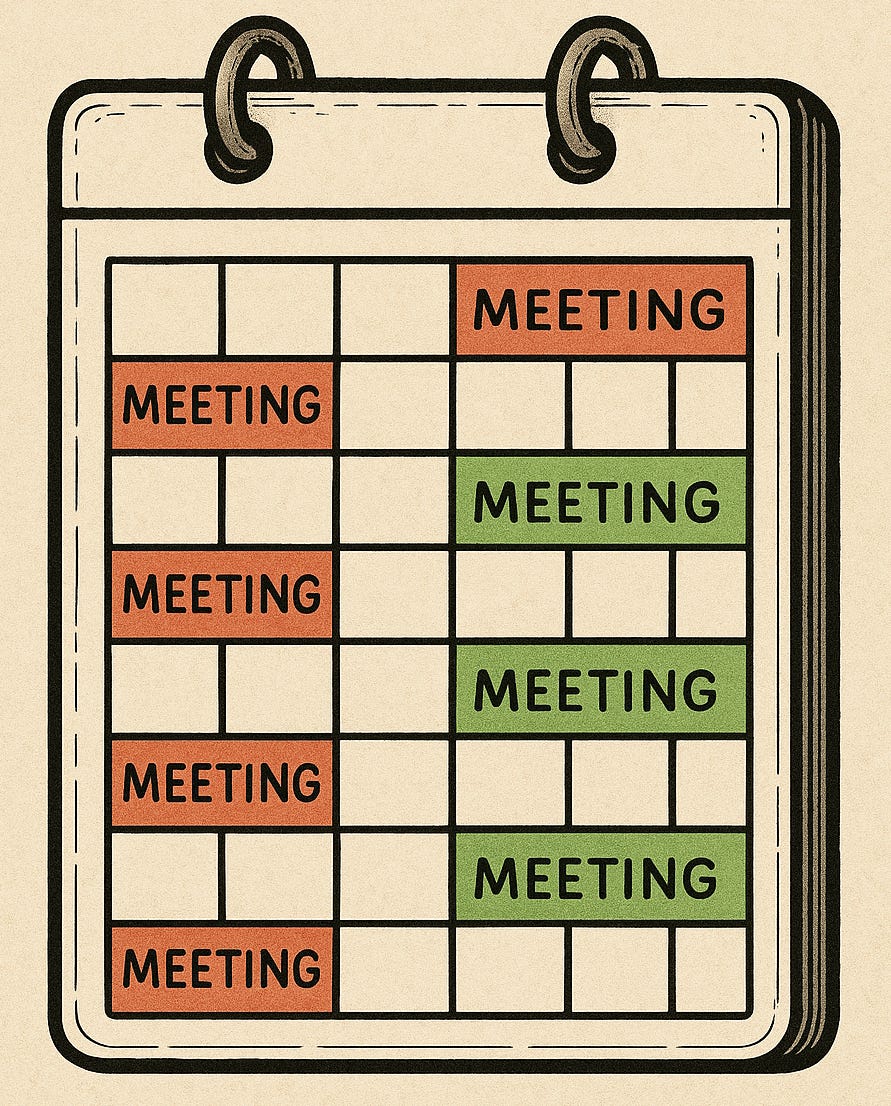
You go through your upcoming two weeks, day by day. For every meeting on your calendar, you ask three questions: Why am I in this meeting? What if I wasn’t? What would need to happen for me not to be?
You’ll discover some interesting stuff. We’ve had clients realize they’re in recurring meetings that used to matter but don’t anymore. The project ended six months ago but the meeting lives on. Or they’re in meetings where their presence is assumed but not necessary. Or worse, they’re in meetings that produce nothing for anyone.
One leader we worked with discovered she was spending eight hours a week in meetings that had no clear connection to any outcome she cared about. Eight hours. That’s a full workday she got back just by asking the question.
The “So What?” Tool
The “So What?” tool is what keeps you honest once you’ve done the Time Audit. It becomes your regular practice for maintaining visibility.
At the end of each day or week, you look at your calendar and task list. Then you ask: So what? What outcome did this produce? What did this do to move my priorities forward? And critically: how much of my time was spent simply maintaining structures or activities that exist because “that’s how we do things” rather than because they serve our strategy?
It forces the connection to be explicit. Not what you did, but what it created. Not the activity, but the result.
We started doing this at the end of every Friday. It takes maybe ten minutes. And what changed is that we started to notice patterns we couldn’t see before. We could see which activities consistently produced outcomes and which ones just consumed time. We could see where we were making assumptions about impact that weren’t holding up.
The uncomfortable part is when you can’t answer the question. When you look at six hours of work and realize it produced nothing meaningful. But that discomfort is useful. It’s the signal you need to make different choices.
The “If I stopped doing this” Test
The third tool gives you a framework for making those different choices. For any recurring activity, you ask: if I stopped doing this, what outcome wouldn’t happen?
If you can’t answer that question clearly, that’s your red flag.
We use this test when we’re looking at commitments that feel heavy. The weekly update no one reads. The report that gets filed but never referenced. The meeting that fills time but produces no decisions.
What it reveals is how many things we do out of habit or obligation rather than strategic necessity. And once you see that clearly, you have options. You can stop doing it. You can delegate it. You can redesign it to actually produce the outcome you need.
We had a client who was producing a monthly dashboard for her leadership team. It took her four hours every month. When she ran the test, she realized no one was using it to make decisions. They glanced at it, filed it away, moved on. She stopped producing it. No one noticed. She got four hours a month back.
The WHY and HOW of it all
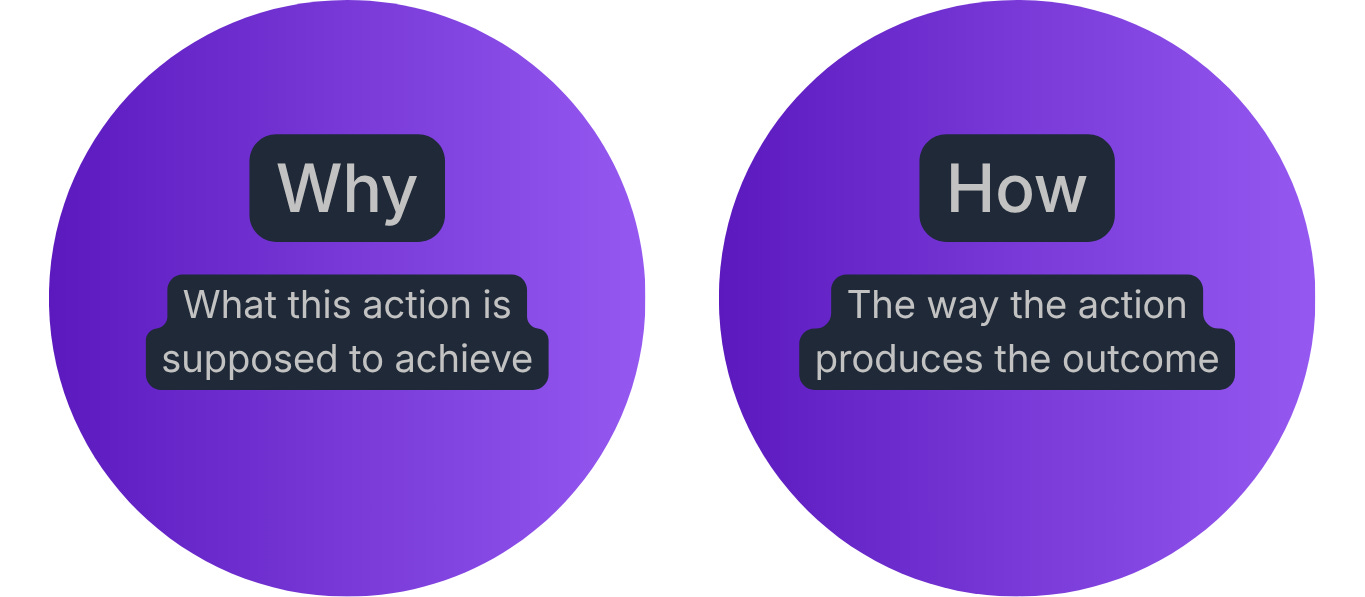
What these three tools are really doing is rebuilding something that gets lost in reactive mode. They’re helping you articulate both the WHY and the HOW.
The WHY is the outcome you’re trying to produce. Why this action matters. What it’s supposed to achieve.
The HOW is the mechanism by which this action produces that outcome. The logic. The theory of change.
Without both, you’re just doing stuff. You might be busy. But you can’t know if you’re being effective.
In reactive mode, we lose both. We do things because they’re urgent or expected or habitual. We can’t articulate how those things produce strategic outcomes. The connection is assumed or absent entirely.
The Strategic Time Audit forces you to examine the WHY. What outcome is this supposed to serve? Often, there’s no clear answer.
The “So What?” tool makes you articulate both. What outcome did this produce? How did my action create that result? It builds the muscle of seeing the connection.
The “If I stopped doing this” test puts both on trial. What outcome wouldn’t happen? How does this activity produce that outcome? It exposes weak or broken connections.
Real Example
We saw this play out with Sarah, a marketing director we worked with last year. She was had a department goal related to increasing digital engagement. Instead of immediately jumping to posting more content, she stepped back. She asked: what business outcome are we really after?
In asking that question, Sarah discovered that lead generation, not increased content was the right strategic focus. By shifting her focus to targeted content that drove sign-ups, she delivered three times better results with less effort. She wasn’t working harder. She was working on the right thing; operating strategically.
Questions worth asking
We’ll leave you with some questions that have been useful for us when we’re trying to connect actions to outcomes:
What’s one project you’re working on where you could clarify the why before the how?
How do you currently measure success? Are you tracking activities or actual outcomes?
And perhaps most importantly: What activities are you participating in that perpetuate structures disconnected from your strategic priorities? What would happen if you stopped showing up?
It’s worth writing down answers to these questions and not treating them rhetorically, because the answers tell you where to focus next.
Action Steps
Run a Strategic Time Audit this week. Pick the approach that feels most useful. Either track your time retrospectively or go through your upcoming calendar prospectively. See what you discover.
Join our Strategic Fitness Benchmarking Study. We’re asking consultants, leaders, staff, and board members to assess strategic fitness inside the organizations they’re connected to. How often do teams pause, ask the right questions, map systems, dig for root causes? We’ll publish a report with practical benchmarks and a collection of tools and practices you can use. Join the study by filling out the interest form here.
We want to hear from you!
If any of this landed with you—whether you’re in the thick of these challenges or you’ve developed strategies that work—we want to hear about it. We’re scheduling 20 minute conversations with leaders to understand what’s helping you stay grounded as a strategic operator and where you’re struggling. Your insights will shape how we build this series and similar future projects. Send us an email at info@hookrodgersconsulting.com if you want to schedule a conversation.